
Finishing the Summer “To-Do” List
Suddenly the days are getting a little shorter, and I am noticing more swamp red maples beginning to turn red in the wetlands and birches turning yellow high on the hillsides. It is still quite warm during the day, but the nights are growing cooler and we are finally beginning to get some much needed rain.
Like the birds and squirrels, I am double checking my summer “to do” list and trying to make sure everything gets done. I am amazed at how many things are still on the list but if you are reading this, at least I got my final Summertime column written!
In addition to looking for mushrooms and elderberries when I hike, I find myself keeping my eyes peeled for grouse, deer, and turkey sign. Those seasons are rapidly approaching, and last year’s venison supply is running low in the freezer. I have been seeing turkeys everywhere and lots of deer sign, a promising sign for the fall season.
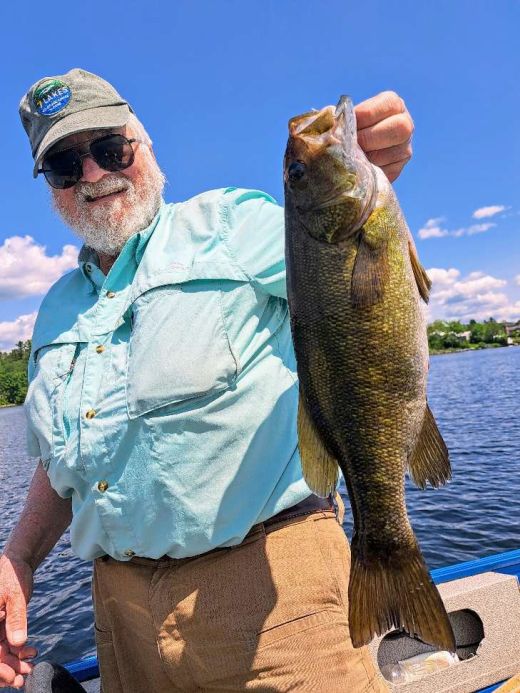
Both the loons and the bass and pike in the lakes are chasing large schools of bait fish, mostly landlocked alewives in Great Pond and Long Pond, and trying to build up fat reserves to get through the winter. The warm surface layer has plenty of oxygen to support the large bass, but the deeper water is largely depleted of oxygen, but has enough to support the large schools of small bait fish. You can watch the larger fish dive down to grab some lunch and then return to surface layer to digest their meal.
Fishing at the base of the layer, around 20 ft., with anything that looks like a minnow, will yield results. I have had good success with a white zonker fly, fished with a sinking tip flyline. I frequently catch three or four, 3-4-pound bass, one after the other. There are still some rainbow trout and brown trout down deep, right around 28 ft. in Long Pond’s upper basin and below 35 ft. in the lower basin. Great Pond is similar to Long Pond’s upper basin.
Additionally, the loons with chicks are teaching their offspring how to catch their own food. When the chicks are first born, the parents chew up fish and crayfish and basically regurgitate food morsels into their chicks’ eager open mouths. The chicks grow rapidly, and the parents soon simply bring the chicks, still wriggling morsels, which the chicks grab hungrily.
After a week or so of this routine, the parents simply drop the food in the water near the chicks and the chicks need to catch their food before it escapes. At the same time, the chicks are learning to dive underwater, which is a major step in evading airborne predators such as eagles. Soon the chicks are foraging for their own food alongside the parents.
Over the next two months or so, the loons will molt, replacing their insulating down with feathers, and begin to learn to fly. Those chicks that learn to fly before the lake freezes over will head to the ocean for the winter and eventually return to the lake, usually after two years on the ocean.
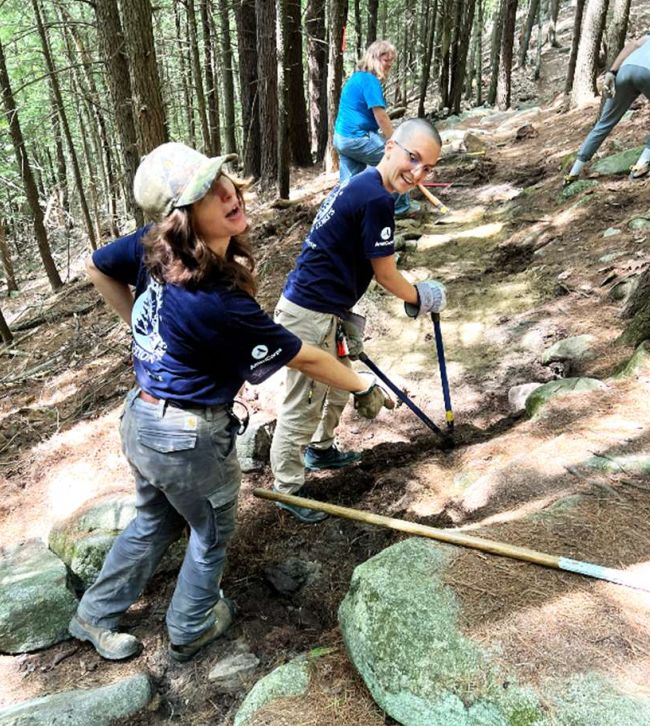
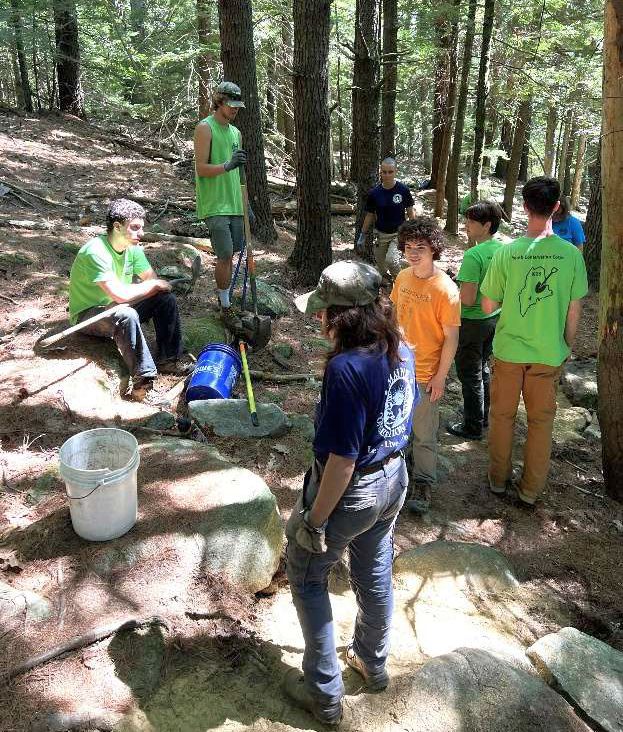
As we discussed last week, the 7 Lakes Stewardship team continues to improve the safety of our trails. McKenna Thompson, an AmeriCorps volunteer working with the Maine Conservation Corps (MCC), has been interning with Dan and overseeing various planting projects this summer, while her fellow MCC teammates have been camping out and working on trails in the Kennebec Highlands. She organized a volunteer workday on Mt. Phillip where her fellow MCC teammates, 7 Lakes Youth Conservation Corps, and a few other volunteers cleared vegetation and rocks to make the trails safer and more erosion resistant.
It is hard to believe that this is the final issue of Summertime in the Belgrades for this year. I hope this column has inspired some of you to get out and explore the outdoor recreation opportunities the region has to offer, and I hope you took a kid or two along. Until next year, I encourage everyone to “take it outside.”
For those who will be around during the fall, get out on some of the trails to view the foliage. It can be truly breathtaking.
For those of you who will be around for the winter, I encourage you to join me on the local trails on snowshoes or skis. The local trails look completely different in the winter with the foliage gone. Carpe ski-em!
If our ongoing Camp Bomazeen Conservation Project is successful — still looking for about $500K as I write this — we will be creating some new trails later this fall and through the winter.
Download Full Newspaper: High Res | Low Res (Details…)
<— Previous Article • Summaries
©2026 by Summertime in the Belgrades. All rights reserved.