
Early Summer Fishing and Water Quality Monitoring
Editor’s Note: Due to the rapid pace of Summertime, the newspaper, the following column was inadvertently omitted. But, it’s great at any date…
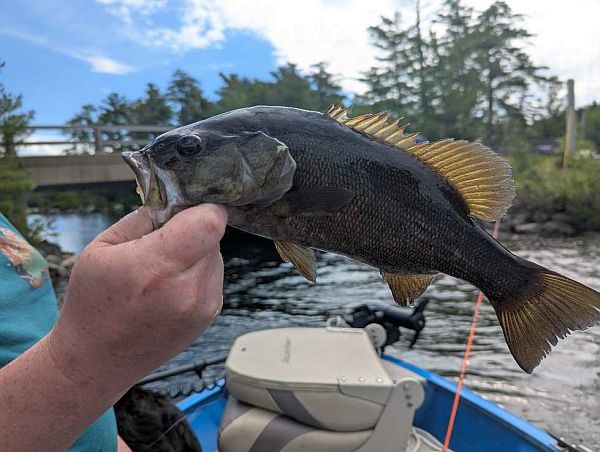
Last weekend included Juneteenth and Father’s Day, as well as one of my regular, biweekly water quality monitoring sessions. Two of my kids came for the weekend: my younger son and my older daughter. My son was here all weekend and my daughter spent Friday and Monday as she was basically passing through on her way to run in the 10K portion of the International Bay of Fundy Marathon in Lubec. Rob and I got out fishing on Saturday and we celebrated Saturday night with fish taco salad made with fresh caught white perch and yellow perch and some pickerel filets from the freezer.
Last week, Mother Nature reminded us all how much power she can generate sometimes and how quickly she can change things up without warning. We had a couple of thunderstorms early in the week that caused some high winds and flash flooding.
These intense weather events can also affect water quality in our lakes, rivers, and streams. Significant precipitation events usually result in large erosion events that can add significant sediment loads when Mother Nature uses her pressure washer instead of her normal gentle rain that infiltrates slowly while removing contaminants.
Typically, the “first flush” is especially contaminated, as it often contains a lot of dust, grease, oils, etc., that is washed off impermeable surfaces such as roofs or pavements. High winds stir up the lake and can change both temperature stratification and currents, as well as causing large waves that cause additional shoreline erosion. Ongoing water quality monitoring programs coordinated by 7 Lakes Alliance (7LA) and Lake Stewards of Maine are in place to help document changes to our water quality and better understand how to protect our water quality.
I am both an invasive plant and water quality (WQ) monitoring volunteer for these programs. While there is a certain amount of altruism involved, there is also a great deal of self-interest and opportunities for other potential rewards. On Sunday morning, after calibrating my (actually BLA’s) WQ meter at the 7LA WQ lab before the farmer’s market, I got out on Long Pond with my son, Rob, his girlfriend and his large German Shephard dog to collect water quality data at both DEP Station 01 (Upper Basin) and Station 02 (Lower Basin) before the predicted afternoon thunderstorms kicked in.
Usually, Father’s Day is a good time to see a lot of daughters out fishing with their dads. Typically, the dad is driving the boat and the daughters are in the bow, catching some rays. This year’s overcast and occasional rain modified that a bit and the daughters were usually steering the boat from a protected cockpit while the dads were trolling in the rain from the fantail.
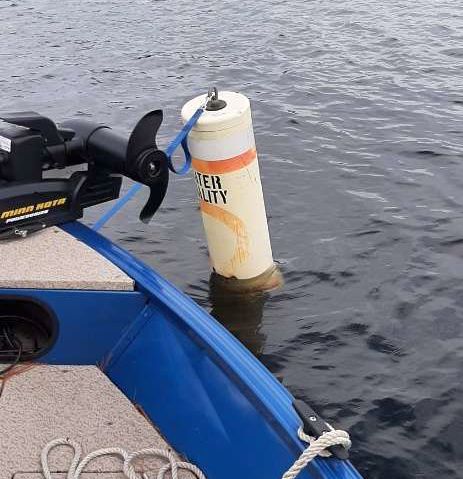
Lake Stewards of Maine (LSM) is a statewide lakes nonprofit is that trains, certifies and provides technical support to hundreds of volunteers who monitor a wide range of indicators of water quality, assess watershed health and function, and screen lakes for invasive aquatic plants and animals. Formed in 1971 as the Maine Volunteer Lake Monitoring Program, it is the longest standing statewide citizen lake monitoring program in the U.S., as well as one of the largest, with more than 1,200 active volunteers monitoring more than 500 lakes statewide. On behalf of the Belgrade Lakes Association Water Quality Committee, I collect dissolved oxygen and temperature profiles every two weeks at water quality test sites (marked by an orange and white buoy) in the deepest parts of both Upper and Lower Long Pond.
After review by LSM, these data are entered into the Lakes of Maine Database. That information not only helps monitor lake conditions and provides independent quality assurance for data gathered by Colby College and 7LA, but also gives me insight into where the fish (especially salmon and trout) will be hanging out. Hint: the depth at which temperatures are between 55° and 65° F and oxygen levels greater than 4 mg/L. This depth changes throughout the year and the fish will move until they find it. If they can’t find it, they will not survive in the lake. Right now, there is good cold-water fish habitat throughout the water column in the lower basin once you get below the warm (70° F+), 6 meter (~20 ft.). The upper basin is beginning to lose oxygen near the bottom and the cold water fish are below 20 ft. and above about 40 ft.
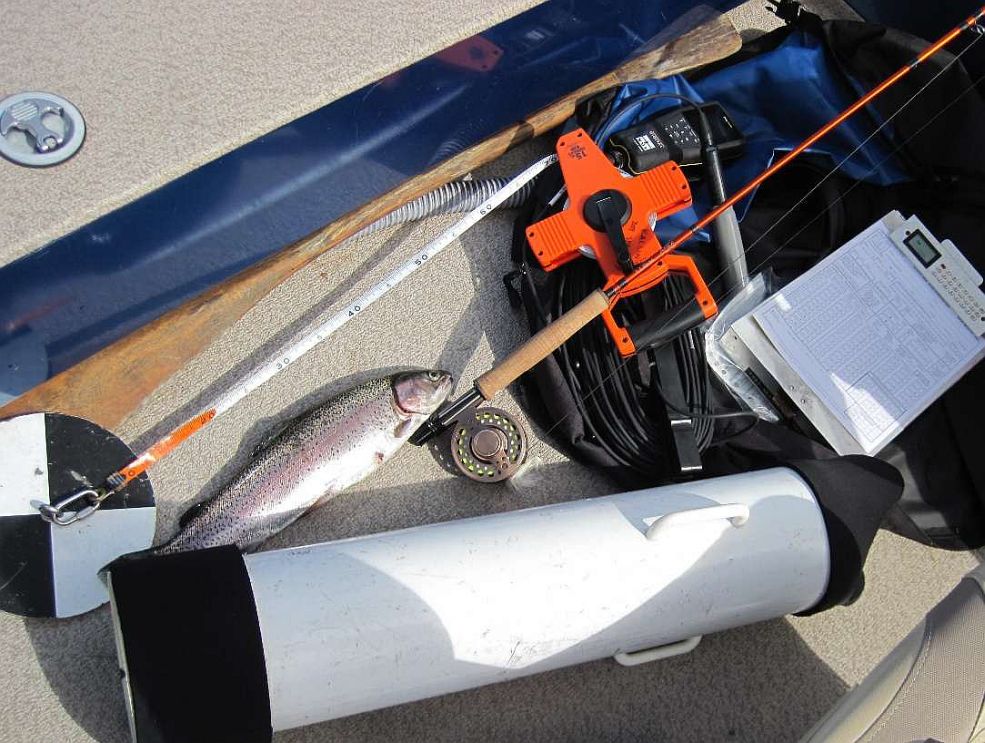
Recently, I was out taking profiles the day after a storm, and as I moved between test sites, I spotted a school of alewives at the right depth for trout. I happened to have my flyrod rigged with a sinking tip line and a fly that resembled an alewife (White Zonker). I cast out and let the fly sink to the appropriate depth and brought it in, twitching it slowly. I was quickly rewarded with nice 45 cm (about 18″) rainbow trout.
A highlight this week was the appearance of at least three loon chicks on Long Pond. The new generation is beginning to appear at all of our lakes and it is a special time to watch the parents nourish their young and teach them to survive on their own. Bring a pair of binoculars so you don’t get too close. I will be talking more about loons in a couple of weeks after the annual loon count on July 18.
Check the 7LA website and Facebook page for upcoming events. Our Thursday afternoon (3 to 4 p.m.) Chewonki presentations are ongoing, and we continue to offer Invasive Plant Workshops and Junior Ranger training on Sunday mornings during the Farmers’ Market. Check with Sally (495‑6039) in the gallery, if you are interested in signing up. I encourage everyone to take advantage of the wealth of recreational opportunities this area offers. Do like they used to in “the good old days” and take a kid fishing, hiking, or paddling in a canoe. It’s how memories are made. Or take a parent, so they can become a kid again.
Download Full Newspaper: High Res | Low Res (Details…)
<— Previous Article • Summaries • Next Issue —>
©2026 by Summertime in the Belgrades. All rights reserved.