
Too Many Adults??
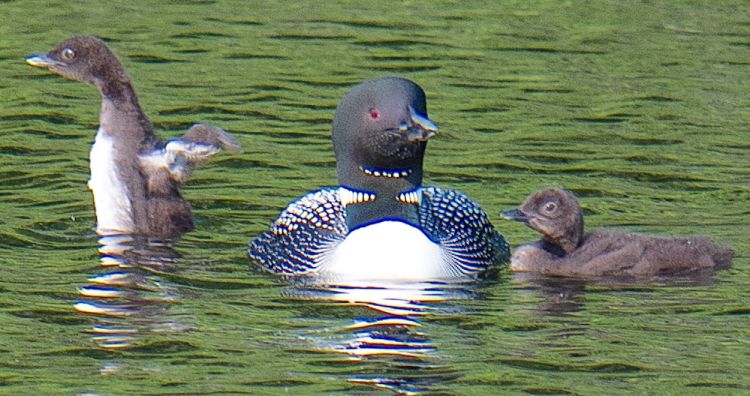
The week of July 18 has been another busy week for loons! It all started on July 18 with our 2026 Maine Audubon Loon Count. As the results of this years’ loon count are still being tabulated, we assume we’re on par with past years.
Looking at the below counts, the numbers can be a bit misleading. Great Pond actually started out last year with eight chicks, but as you can see below, by the day of the physical count, we had lost every one of the chicks due to a myriad of causes: loon territorial disputes, siblicide, bald eagles, snapping turtles, etc. Long Pond had also started last year with eight chicks, but by the Count on July 19, we were down to just two chicks and by the great fall flyoff, we had lost another one. So, for 2025, out of a total of 16 chicks, both Great and Long Ponds produced just one chick that made it to the fly off!
As I pen this week’s column, we still have eight chicks on Great Pond (like last year!) but we are down to just one chick on all of Long Pond. We also have six abandoned eggs so far that obviously should have been chicks. In trying to make some sense out of these numbers, we must keep in mind that the forty-year-old Maine Audubon Loon Count tallies only adult and chick observations during a 30 minute period in time from 7:00 to 7:30 a.m. on a Saturday morning. The morning in question could have been rainy, windy, wavy, foggy, etc. Under any of these conditions, our dedicated volunteer observers would be certainly handicapped.
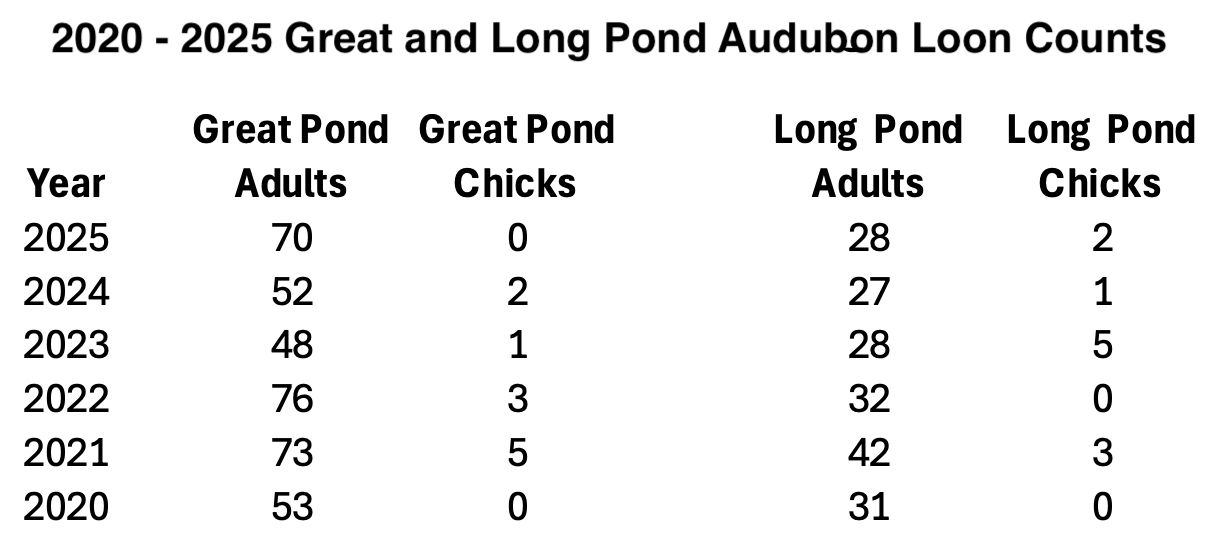
So, what does this lack of chick productivity, or maybe a more judicious question would be, what does this level of chick mortality have on our overall adult loon population? Should we be expecting a precipitous drop in our adult loon population? Both Great and Long Ponds, under the auspices of the Belgrade Lakes Association’s Loon Preservation Project, have been surveyed on a seasonal daily basis for the past eight years by our two full-time Colby College Loon Interns in addition to numerous dedicated volunteers.
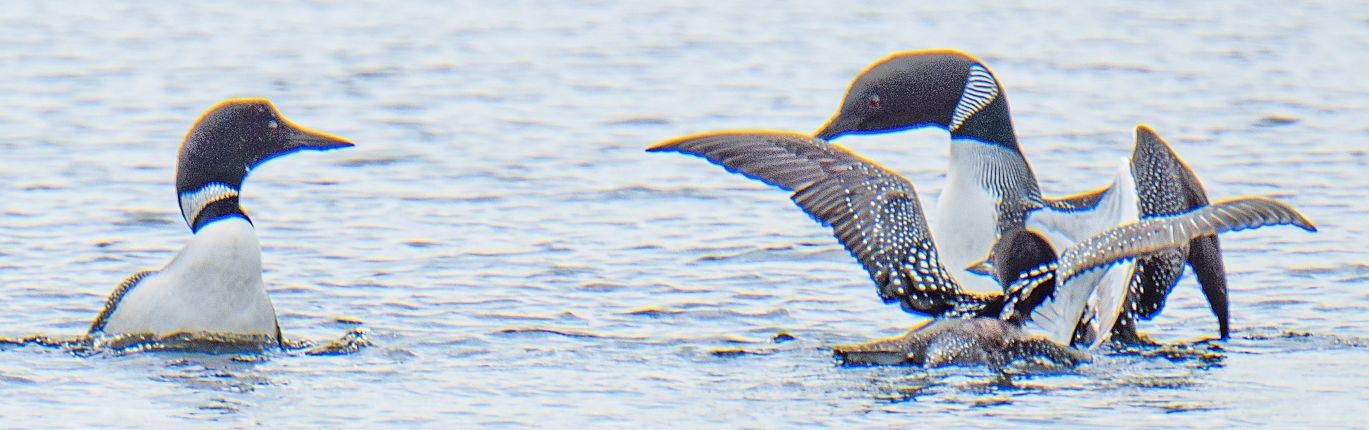
One question that we are now pondering is, “Do we have too many adult loons for the twelve or fourteen loon territories in each of our two lakes?” We know that we have the water quality, clarity, and fisheries population that make the Belgrade Lakes attractive to not only our residents and visitors, but our eagles, osprey, and loons as well! We are observing numerous territorial disputes resulting in the loss of both adults and chicks. Are we seeing more today than in years’ past? We can’t say but it’s worth further study.
If you have a particular questions regarding our Belgrade loon population, please email , and we will try to answer your question either in this column or via email. We still have a lot of summer left, so we hope you’ll continue enjoying the “call of the loon!” We are so fortunate to summer here in the Belgrades!
Dick Greenan is chairman of the Belgrade Lakes Association’s Loon Preservation Project.
Download Full Newspaper: High Res | Low Res (Details…)
<— Previous Article • Summaries • Next Article —>
©2026 by Summertime in the Belgrades. All rights reserved.