
Counting Loons

The third Saturday in July is the annual loon count in Maine, coordinated by Maine Audubon. This year’s count took place July 18. It was the 43rd annual count in this important ongoing citizen science project dedicated to better understanding one of Maine’s most iconic birds.
Every year over 1000 volunteers, of which I am one, attempt to count all the loons on over 300 Maine lakes at the same time. It’s organized like a military operation, and I am the coordinator for the dozen or so volunteers on Long Pond, which is divided into nine Survey Areas, with a tenth on Ingham Pond. Scott Chapman is my deputy coordinator for Lower Long Pond. Scott is a second-generation counter. His late mother counted loons every year for decades, usually with young Scott in the boat.
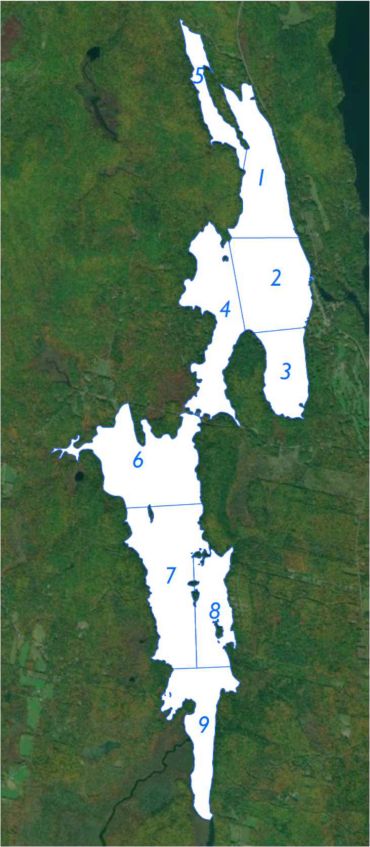
Early in the morning, all counters head for their assigned section of the lake to be in position to count all the adult loons and loon chicks in their area between 7:00 a.m. and 7:30 a.m. This year I had a new set of counters, Rick and Sara Barry from Beaver Brook Estates, doing Sector 4. As you can see by the picture below, they were both excited and having fun during their first-time survey. The weather was excellent for counting loons: partly sunny with light winds out of the west. This year I was assisted by Peter Alter from Fawn Point, whom I picked up at his dock on the way to our survey area.
Our assigned area was a cove that was used for many years by a pair of loons that used to nest on a secluded beach on a small peninsula and often lost their eggs to land-based and avian predators that found the nest and ate the loon eggs before they hatched. Seven years ago, the Belgrade Lakes Association, as part of their ongoing study of loons on Great and Long Pond — for more information, see Dick Greenan’s loon articles — built and installed a floating raft nest with an avian guard to prevent predation by eagles, ravens, and blue herons. The nest is moored about 15 feet offshore from the usual nesting site to provide the loons some protection from terrestrial predators such as racoons, minks, et al.
When land-based predators have to cross water to reach the nest, the defensive advantage shifts strongly in the loons favor! For four of the past five years, the loons have successfully used this nest. A chick was born near the end of June but died over a week ago.
As we approached our area from the north, we spotted four loons entering our sector, a group of three who were looking into the water for food, and a fourth that was likely one of the cove parents about 30 feet from the trio that periodically rose up out of the water and flapped its wings at the others. We continued through our sector and found the male parent (orange and green bands on leg) still feeding near the nest.

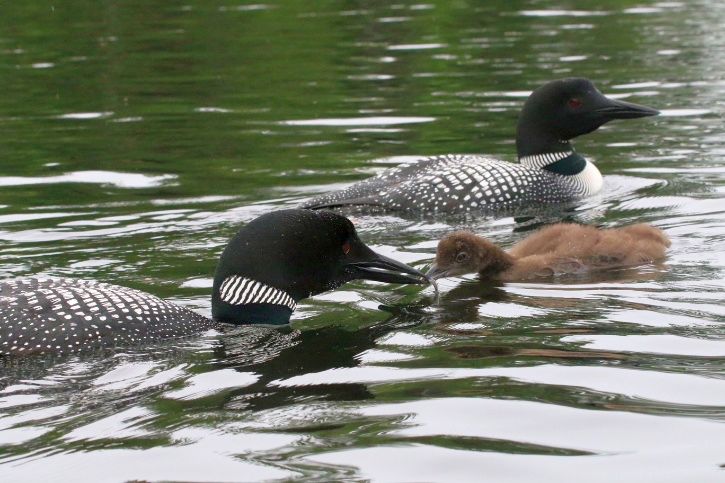
We completed our sector and relocated the feeding raft of loons near the western shore and an additional loon had joined them. When I returned, I contacted Jason and Sarah Toner, who had surveyed Beaver Cove to see if they had a good picture of the chick I could use for this article. They apologized profusely and said they were both so excited to locate the parents and chick that they forgot to take pictures. The picture below was actually taken by Dick Greenan the day before the count but it is the same chick. As of press time, I had not received results from all of my counters, but it appears likely that chick numbers will be down a bit from last year in Long Pond but adult loons should be roughly the same as last year.
Take advantage of the rest of the summer and get out on the lakes or hike or bike in the hills. And take a kid along. Or a parent or grandparent. You will be creating memories that will last. 7 Lakes Alliance is hosting many interesting events, including Thursday afternoon, 3:00 –4:00 p.m., presentations by Chewonki. More info is available at the 7 Lakes website. Pick up the latest map of the local trails from the 7 Lakes Alliance at 137 Main Street in Belgrade Lakes Village. Individual trail maps for most of the trails can be downloaded from their website.
<— Previous Article • Summaries • Next Article —>
©2026 by Summertime in the Belgrades. All rights reserved.