
Memories of Camp Abena
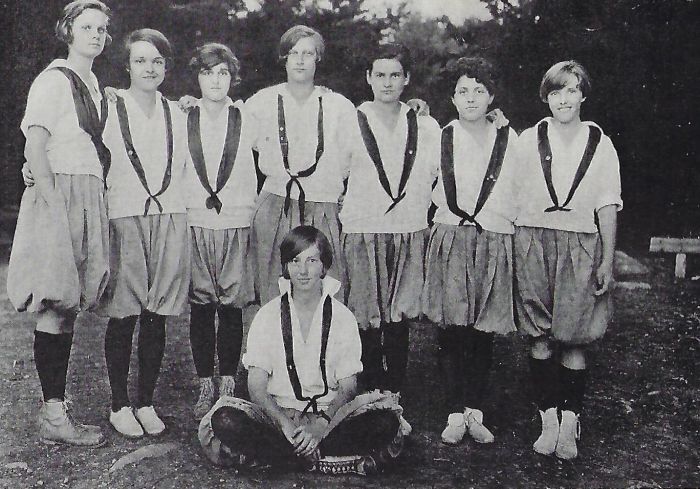
Among the letters, I found in the attic of our old farmhouse was a booklet, “The Abenaque”. Dated 1926, this booklet was a souvenir for the campers of Camp Abena, Belgrade Lakes. It was written by the campers and describes their time at the camp and had individual pictures of all the senior campers. This volume was marked No. 4 and was the final issue of the summer of 1926. There was a detailed description of the farewell dinner; therefore this volume was probably sent to the camper’s homes after the end of camp.
I later learned Camp Abena (pronounced A-bey-na) was founded in 1907 by sisters Hortense and Rilla Hersom. It was only the second girls camp in the state. Miss Hortense Hersom was born in Belgrade, Maine and had become a school teacher. She taught in Farmington, Me., Boston, Mass., and at the Sidwell Friends School in Washington D.C.
In the early 1900s, outdoor camps for boys became popular, and many parents sent their sons to camp to learn outdoor skills. Miss Hersom was encouraged to establish a camp for girls. As Camp Merryweather for boys had already established in Belgrade in 1900, an ideal place for a girl’s camp would be on the 100-acre peninsula on Great Pond in Belgrade that was in the Hersom family. Miss Hersom along with her sisters, Rilla, a registered nurse, and Dora H. Lambert and her husband, Avery E. Lambert, a professor at Middlebury, Vermont successfully opened a camp for young ladies to learn outdoor skills. The camp was named Camp Abena in honor of the Eastern Wabanaki Indians, “people of the dawn,” a tribe of the Algonkins who once lived in the area.
“The Abenaque” has many details of what life was like at Camp Abena in 1926. There were tennis matches, canoe trips, musical events, dramatic plays, and pageants. All the girls wore the same camp uniform of khaki bloomers with a white middie blouse and black tie. Sunday uniforms were white bloomers with white blouse and a gold tie. All the girls wore Bass Camping shoes which had to be ordered from Hanold Outfitting Co of Standish, Me. and fitted at camp on opening day.
My favorite part of “The Abenaque” was the fifty-five individual pictures of the senior girls. The pictures were arranged alphabetically and gave each girl’s name and how many years she had attended Camp Abena. Many of the girls had been attending for two to six years. Almost all the girls sported short hair styles as bobbed hair was the fashion during the 1920s. There was also a four-stanza poem to commemorate each girl. My favorite poem was the one written for Elizabeth Scull as follows:
The opportune moment we seize To exclaim, “That girl’s sure the bee’s knees!” For because she is a Scull O’er the waves gentle hull, She embarks on all ventures with ease.
Dianne Dowd is a member of the Belgrade Historical Society.
<— Previous Article • Summaries • Next Article —>
©2026 by Summertime in the Belgrades. All rights reserved.