
Long Days With Loons
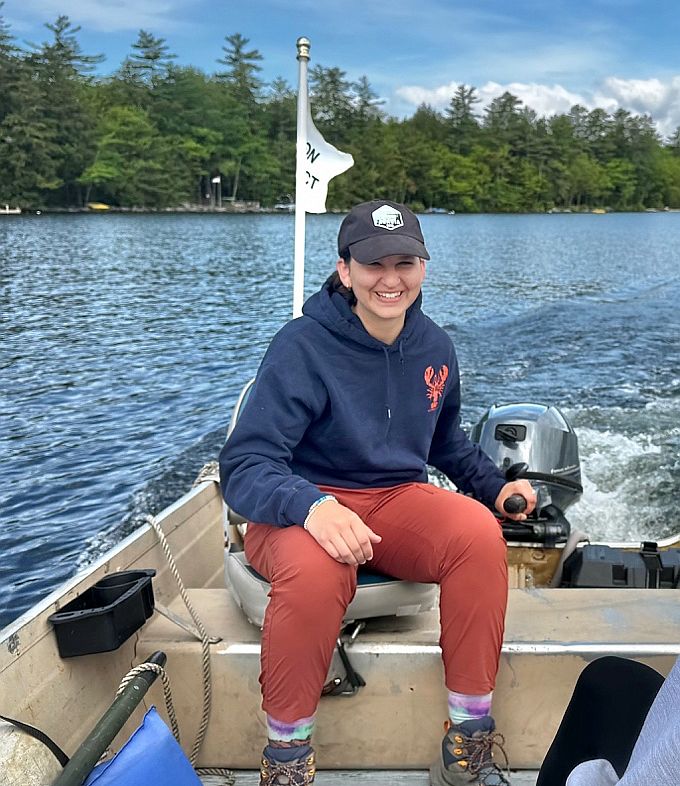
Four hundred miles from home in Vacationland, my alarm goes off at 5:00 A.M., and I’m immediately jolted awake. I hop out of bed excitedly anticipating what another day on the Belgrade Lakes will bring. The morning is cool, as we drive out. With binoculars around our necks, we are covered in thick layers of sunscreen and bug spray. Alie, my fellow intern, and I carefully ease ourselves into our survey vessel, a 15′ aluminum outboard boat, and shove off from the dock. All is quiet so early in the morning. No traffic noise, no boat noise, even the water is quiet. I am reminded that this is “the way life should be” in the great state of Maine. Suddenly the seemingly somber and mournful wail of the common loon cuts through the silence, reverberating hauntingly around us from a great distance. I close my eyes and listen in awe. It doesn’t take us long before we have our first sighting.
Just ten feet from our craft, a diving bird pops up out of the water and bobs around curiously. We can both tell from the obvious field marks — checkered black and white back, jet black head, striped zebra-like collar, and bright cherry red eyes — that it’s a breeding adult loon. In fact, they are incredibly difficult species to misidentify.
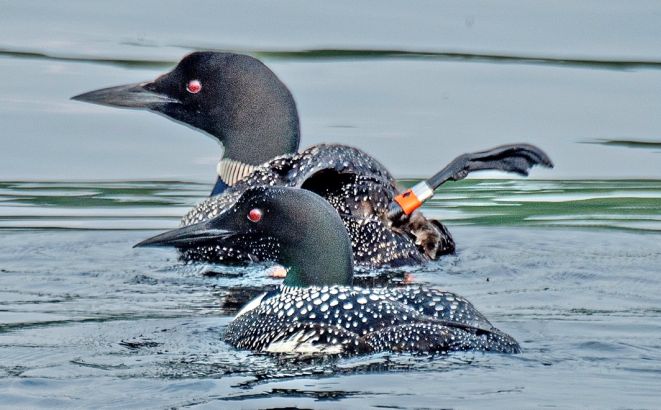
Loons are what some biologists may call an indicator species. This means that their presence on a lake indicates relative ecosystem health. There are truly no other creatures like them. Loons are especially known for their charismatic behaviors and looks, but with our mission as interns, our eyes are trained on just the tail end of the bird. Binoculars glued to our faces, we look at each bird’s legs for the presence of bands that help us identify which individual we are seeing. A red striped band over green on the left leg and orange dot band over silver on the right tell us that we are in the presence of the Blueberry Island 2023 female.
She is typically hard to identify as she makes a habit out of avoiding us, diving under the water as soon as we approach. Her mate, however, an unbanded male, spends lots of time preening and showing off his shiny unbanded legs every time we get close. He puts on quite a display, rolling around, dramatically splashing and extending his wings. It’s almost like he’s intentionally setting up a distraction so his mate can make a subtle getaway. Every day spent with the loons is another day we get to know them. Each bird is unique and has its own curious behaviors.
I have spent my whole life as a “bird nerd.” A couple years ago I collected and inventoried all the bird books, encyclopedias, field guides, and even novels with birds pictured on their covers in my house: 137. I learned birds from the best birder I know: my father. He learned from his grandfather. As I aspire to work with birds after college, I really could not think of a better way to spend my summer than to be in the company of loons on the beautiful Belgrade Lakes.
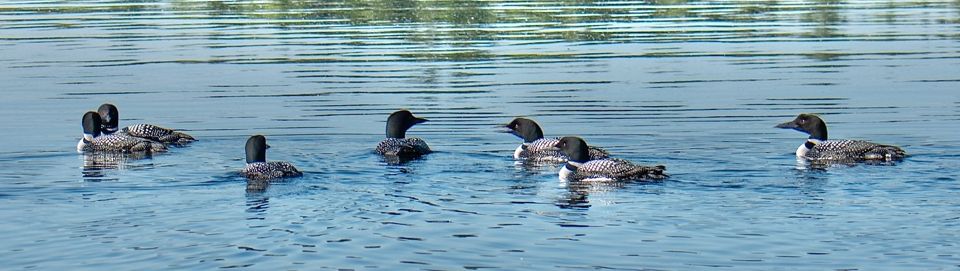
Katie Lutz of the Colby College Class of 2029 is one of two Loon Project interns this summer. Last week, we heard from her compatriot, Alie Forker.
Dick Greenan is chairman of the Belgrade Lakes Association’s Loon Preservation Project.
<— Previous Article • Summaries • Next Article —>
©2026 by Summertime in the Belgrades. All rights reserved.